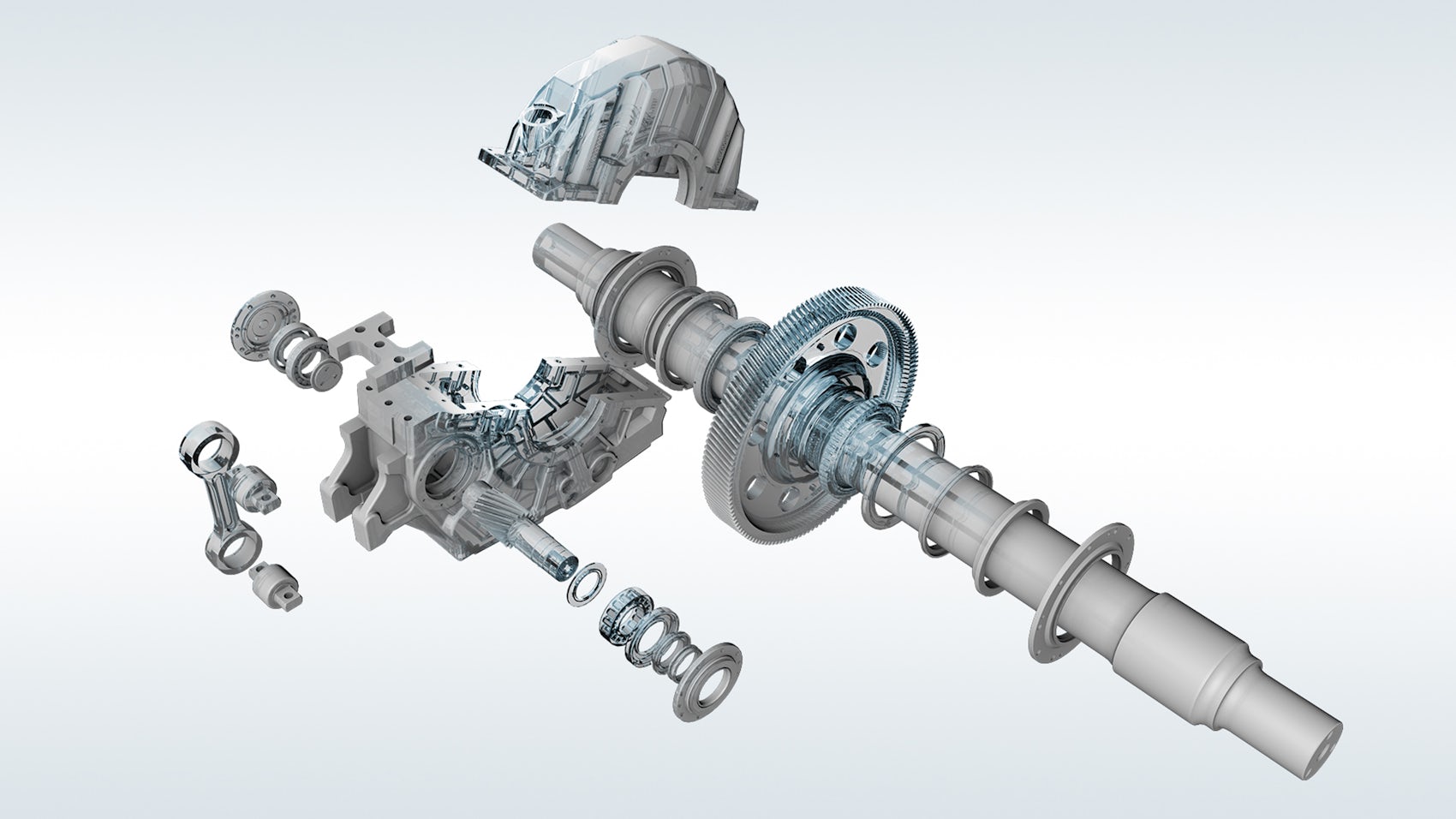
A picture is worth more than a thousand words. Success in design, manufacturing, and procurement reflects the ability to share information in a meaningful way. Sharing is accessing, understanding and utilizing data from another department, from another company, from another discipline –– across geographies and enterprises. Sharing intellectual capital speeds time to market. By sharing, companies increase ROI.
In the product lifecycle management process, much of the shared data is 2D and 3D graphical information. Often the most effective way to understand this data is to view it.
PLM Vis is a component technology that enables rapid development of collaborative applications by enabling a client to:
PLM Vis components are ActiveX/Java beans that enable the rapid development of applications. These components leverage the global reach of the Internet or can be local. They support any architecture from client-server to standalone applications. PLM Vis enables the development of products that display, navigate and print data saved to a large number of popular data formats. PLM Vis offers collaborative tools such as view-markup, view-capture animation, measuring functionality, and a common platform for working with data from a variety of sources.
Customer needs vary with the situation and PLM Vis is flexible enough to deliver in a wide variety of cases, including:
All of these apply equally to OEMs and end-user companies. It is extremely easy to develop an application with PLM Vis. There are drag and drop development environments such as Visual Café and other environments such as J-Builder offer more intimate control.
PLM Vis provides core Siemens PLM Software visualization and collaboration technology that can be embedded in stand-alone applications and Web-based solutions. PLM Vis combines the performance of native code, included in underlying DLLs, with the portability of JavaBeans and ActiveX components. It leverages 250 man years of development of a core visualization engine and associated collaborative tools.
Architected as components, PLM Vis enables the development of a common platform for sharing and working with data originating from both different and competitive applications. It is the only component technology that fully supports JT.
PLM Vis JavaBeans and ActiveX controls can be used for developing applets, applications, and even browser plug-ins. PLM Vis is available on UNIX as well as the PC.
PLM Vis components make full use of JT. These include levels of detail (LOD), assembly support, dimensions, measuring, text, and product manufacturing information (PMI).
In addition to 3D JT, STL and VRML, PLM Vis can support almost any 2D data format in use today, working with 2D and 3D data originating from all the major CAD systems.
JT is a mature lightweight data format with widespread use in the automobile and aerospace industries. Siemens PLM Software offers market-leading applications ranging in sophistication from 2D view markup to 3D simulation in immersive ‘cave’ environments. These applications are part of the Teamcenter Visualization suite with JT as their primary format. Unigraphics CAM machines JT data.
Siemens PLM Software encourages wide use of JT, providing the entire CAD/CAM industry with the means to write JT data economically. Third parties have developed businesses around developing and selling licenses to translators from the popular MCAD systems into JT. It is very often the only format common to the major applications used in an enterprise.
JT data can be very lightweight – holding little more than facet data – or it can be richer and hold associations to the original CAD information, assemblies, product structure, geometry, attributes, meta data, and PMI. It supports multiple tessellations and LOD generation.
PLM Vis Base, PLM Vis Standard and PLM Vis Pro represent successive levels of functionality and a natural upgrade path. The benefits to using these components are that each one will interpret the data it supports and automatically generate graphical output in a standard pane yet still support custom mouse interrupts, selection and colors. Functionality highlights include:
The components listed above are architected as JavaBeans or ActiveX controls. At a lower-level of participation we do also offer PLM Vis JT. It is a C++ library that applications can use to read and write JT data.
5800 Granite Parkway
Suite 600
Plano, TX
75024
USA
Share this page through any of the following channels.